
How to Hire a Virtual Assistant for Your Real Estate Business


I had a chat with an agent recently who was trying to put together a letterbox drop. Not writing it, not deciding which streets to hit, just building the thing. She didn't know which tool to use, didn't know how to set the artwork up for print, and by the time we spoke she had lost most of an afternoon to it and still had nothing she was happy with.
That afternoon cost her more than she thinks. It wasn't just the hours. It was the fact that by the time she got to the end of it, she was so over the whole idea that the drop never went out at all.
This guide is about fixing that particular problem, and about a dozen others like it, by putting a full-time assistant in your business for a fraction of what you would probably expect to pay.
I recently sat down with Damon Simms from VentureX for the podcast. Damon places offshore staff with New Zealand businesses, and he spent six and a half years in the Philippines, three in Malaysia, and several more in Hong Kong recruiting in that market.
PODCAST VERSION
To listen and subscribe to the show, search 'Agent Monday' on Spotify, Apple podcasts, or any popular podcast app.
The real reason this matters
The skills that make you good at selling houses and the skills that make you good at supporting someone who sells houses are two completely different things. When salespeople try to do both, they get bogged down, the support work gets done badly, and the selling work suffers as a result.
You know what that looks like from the inside. You fight your way through the admin, you get some marketing out the door, and it works. You get busy. Then, because you are busy, all the consistent marketing and database work stops. Three months later you come out the other side of that busy patch with an empty pipeline and you start the whole cycle again.
That income roller coaster is not a motivation problem. It is a capacity problem, and it does not resolve itself by trying harder.
What the offshore talent pool actually looks like now
If your mental picture of offshore support is a room full of people in headsets in a call centre somewhere, working through a queue of jobs for a dozen different clients, it's time to update it.
VentureX places mid-career professionals, people with five to ten years in the workforce. Damon told me that close to 100 percent of the people they place are university graduates, with full home office setups.
The scale of the talent pool explains it. The Philippines has over 100 million people. Metro Manila alone is around 12 million. English is a national language and the country produces hundreds of thousands of graduates a year.
The part that got my attention was how much real estate-specific experience is sitting in that pool. Damon has recently placed someone with multi-year experience across Vault who had worked for a large franchise brand in both New Zealand and Australia. In property management, he found a candidate who had been running a rent roll of around 200 properties for a South Island agency, dealing with tradies, arrears, tenants and landlords, and taking inbound calls. The agents on the ground were only doing the things that physically required someone to get in a car.
Three ways to hire, and why the model matters more than the price
There are three common routes and they produce very different results.
The BPO or outsourcing agency.
A company in the Philippines employs someone and sits them in their office, with a layer of management between you and them. As Damon put it, what you are buying is a seat, not a person. The person in that seat can change, so the knowledge of your business never compounds, and staff tend not to stay long.
The freelance marketplaces.
Upwork, Fiverr and similar. Damon described onboarding a client who had spent weeks trying to hire on Upwork and gave up, buried under applications and not seeing what they needed in any of them. If you have ever posted a job on one of these and had 200 responses in a day, you know exactly how that feels.
Direct hire.
You employ the person. They work for you, learn your business, and stay. Damon's argument is that offshore recruitment should be run exactly like onshore recruitment: know where to advertise, know what questions to ask, and treat the candidate like a person rather than a unit of supply.
I asked him what the working relationship feels like in practice. His answer was that with Google Meet, Slack and the rest of it, it is close to having someone sitting in your office. Not identical (and I will come back to the difference) but close.
What it costs and how long it takes
Damon puts salary in the range of $10 to $15 NZD per hour. Toward the top of that range you get significant experience. At the bottom you are still inside the mid-career professional bracket, but with less depth. Below that range, in his words, you get what you pay for.
VentureX charge 15 percent of annual salary as a placement fee, and that comes with a 90 day staff replacement guarantee. If your hire gets dismissed for cause or simply walks away inside that window, they find you a replacement.
On timing, he quotes 15 business days but says a shortlist is often together within a week, partly because they now have a database of candidates with real estate experience to draw on.
What you would actually give them
The most common objection I hear before anyone gets this far is some version of "I wouldn't have enough work to keep them busy."
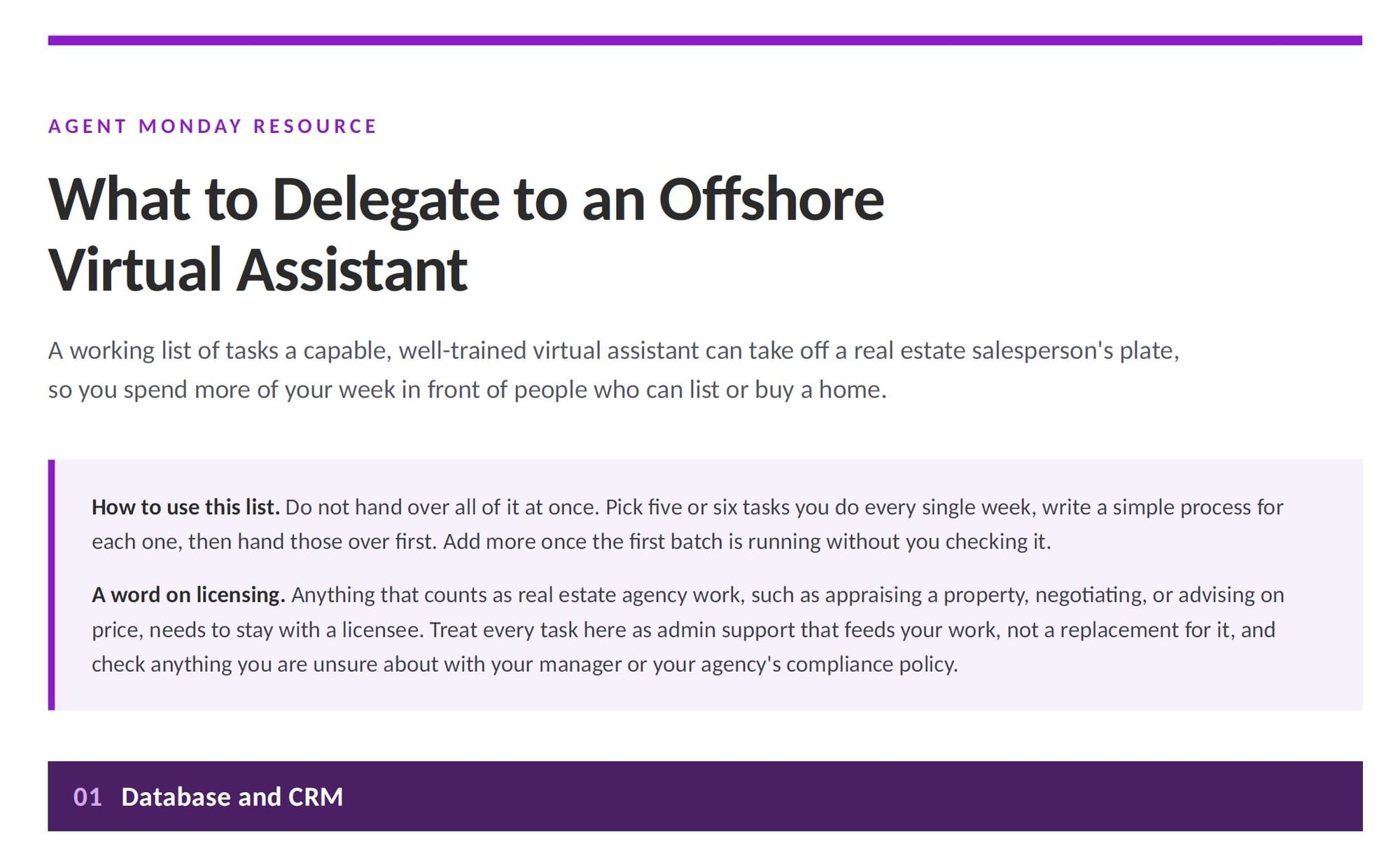
I have put together a downloadable VA task list covering everything from database and CRM work, prospecting support and appraisal prep through to campaign coordination, buyer enquiry management, vendor reporting and settlement tracking. There is even a separate section at the end covering property management. It runs to well over 100 tasks and I promise you will not get through them all.
Use it as a menu, not a job description. Pick five or six things you do every single week, hand those over first, and add more once the first batch runs without you checking it.
The two things that make or break it
Damon has seen enough of these relationships go well and go badly to be clear about what separates them.
Document your procedures.
Most of us do not have documented anything. We have systems in our heads. The good news is that this is a job you can hand to the assistant themselves. One of the first things I did with my own PA years ago was have them write down what we did and how we did it, step by step, as they learned it. You end up with a manual you never had to write, and a person who understands the business better for having written it.
Show them what good looks like.
Do not describe the outcome, show it. Build a scrapbook. When you see marketing you like, save it or take a photo to share with your VA.
A local agency near me dropped a Halloween door hanger in my letterbox one year. It was a flyer you could hang on your front door telling trick or treaters whether you were happy for kids to knock, branded to the agency. Every parent walking past with their kids saw it. Clever, cheap, and memorable.
If you want that this year, don't spend hours designing the piece, researching printers, comparing cost per unit across five quotes. Send your virtual assistant a photo of the example, saying 'recreate this, find me the best print option, I want 2,000'. Job done.
The cultural difference nobody warns you about
Across much of Asia, the concept of losing face carries far more weight than it does here. In an employer and employee relationship, that can show up as someone saying yes when they do not really mean yes. They may not have understood, or may not agree, but saying so directly feels disrespectful.
VentureX screen for this during recruitment and stay involved with both parties for the first month specifically so that either side can raise something before it turns into a problem. But knowing the dynamic exists changes how you check in. Instead of "does that make sense?", ask them to talk you through how they are going to approach it. You will find out immediately whether it landed.
Practical risks worth planning for
The Philippines sees 23 or 24 typhoons a year. Not all of them will hit your assistant, but over time one probably will, and it may cost a couple of days.
VentureX screen for backup power, backup internet and a nearby cafe, hotel or co-working option. The risk is manageable, as long as you have planned for it rather than being blindsided when someone does not appear one morning.
Time zones actually work in our favour
There is a four-hour difference, going out to five in our summer. A 9am New Zealand start is a 5am start for them, which is early but nowhere near a graveyard shift. Damon says candidates prefer New Zealand employers over American ones for exactly this reason. One candidate pointed out she would finish at 3pm, right when her kids get home.
If you need weekend cover, which most of us do, that is a conversation to have upfront and it is not unusual.
For managers and business owners
This might be the biggest opportunity in the whole conversation.
Damon recommends one assistant shared across four salespeople, which gives each agent roughly ten hours a week. The shared model has an advantage the individual one does not: that person builds up geographical and institutional knowledge about how your office works, and it compounds.
Think about what that does for onboarding. Right now, a new salesperson walks in the door and has to set up their profiles, their bios, their website page, their accounts across a dozen platforms, and build a pre-listing kit and a profile brochure from nothing. Your office administrator is flat out managing listings and contracts and cannot help. So the new person spends their first three months learning a plethora of online tools instead of talking to people, and a huge proportion of them do not survive.
With a shared assistant, you say: "Everything you set up for the person who started six months ago, do it for Sally, who starts Monday". She is out in front of people that same week, ready to rock and roll.
Where to start this week
- Work out your hourly rate using the calculation above. Understand the value you could gain by delegating $20 per hour tasks.
- Download the task list and mark every task you personally did in the last seven days.
- Circle the five you do every week without fail. That is your starting job description.
- Start your scrapbook. Collect the marketing you like and save examples of what good looks like.
- Have a conversation with someone who does this properly.
A conversation about your business
If you want to think out loud about whether this fits your business, book a call with me. We can look at where your time is actually going, what would be worth handing over first, and whether a virtual assistant, a shared office resource or something else entirely is the right move for you right now.
If you would rather go straight to the source, Damon can be reached through venturex.co.nz. He was clear that he does not take a heavy-handed approach and is happy to talk to people who are still just gathering information.